Back to CD catalogue   Check/Modify Basket
Recordings to celebrate the world of the oboe


OBOE SONGS
These downloads cost from £0.50 each, depending on length.
They can be combined with CD orders, but even if you aren't ordering a CD please humour the software by giving a postal region and copying your billing address into the delivery address.

There are no postal or other charges for downloads, and there is nothing to join.
For Credit Card payments the minimum is £0.99; for PayPal £0.50 works fine.
When payment is accepted, you get a link to each download.
This link is also on your confirmation email, and is active for at least 24 hours.

After going to the basket, return here via your browser's Back button.


New to downloads,
or want more information?
Click here.


Any problems, contact
mail@oboeclassics.com

song and price artist/subject album details
Ravel,
Le Tombeau de Couperin
Forlane: Allegretto

with Julian Milford (piano)

Gentle, exquisite, melancholy


6 mins 48 secs; £0.75
photo
of Emily Pailthorpe by Philip Sharkey
Emily Pailthorpe
CD cover picture -
Though Lovers be Lost
Album details
   Listen to sound clip
Ravel wrote Le Tombeau de Couperin for solo piano over the period 1914-17 as a memorial to friends killed in World War I. He chose to make the music a double memorial by stylistically harking back to the earlier glories of French Baroque music. He orchestrated it in 1923, choosing the poignant sound of the oboe to carry much of the melody. This special arrangement by Daniel Pailthorpe bears both the orchestral and the piano versions in mind.
© 2003 Emily Pailthorpe
Bliss,
Quintet for oboe & strings: Vivace

with Simon Blendis, David Adams (violins), Louise Williams (viola), Jane Salmon (cello)

Irrepressible, foot-tapping music
5 mins 46 secs; £0.75
photo
of George Caird by Phil Hitchman
George Caird
CD cover picture -
An English Renaissance
Album details
   Listen to sound clip
Arthur Bliss wrote his Oboe Quintet in 1923. The frenzied opening of this third movement plunges us into a world of virtuosity and vivid expression. Just as the impetus is established, Bliss introduces an Irish jig as a brilliant new idea, and the music becomes more and more frenzied, eventually disintegrating into a quiet passage in which the jig is pitted against cross-rhythmic strings. But the momentum is soon resumed and the Quintet brought to a virtuosic close. © 2004 George Caird
Albinoni,
Adagio in B flat from Concerto Op 9 No 2

with Combattimento Consort Amsterdam,
conductor J W de Vriend

A sublime oboe soaring over the strings

4 mins 27 secs; £0.65.
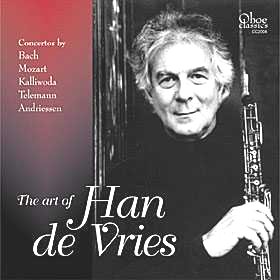
photo of Han de Vries
Han de Vries
Download only - not available on an Album; but for more of Han de Vries on Oboe Classics, click here
   Listen to sound clip
The reputation of Tomaso Albinoni (1671-1751) is probably higher now than at any time since his own age, when his intrumental music was much in demand all over Europe, particularly among amateurs. His oboe concertos were the first of their kind by an Italian composer to be published, and he treated the oboe much like the human voice in his many arias, demonstrating his remarkable melodic gifts to the full. © 2007 Jeremy Polmear, with thanks to Michael Talbot and the Grove Dictionary
Stephen Dodgson,
Suite in D, 1972:
Prelude - Ground - Canzonet - Dance


with Katharine May (harpsichord)

Haunting and vibrant

8 mins 43 secs; £1.00
photo
of Althea Ifeka by John Clark
Althea Ifeka
From Leipzig to London CD cover
Album details
   Listen to sound clip
Stephen Dodgson feels he owes his commitment to the clarity of texture in his music to Janácek and Stravinsky, something that is very apparent in the Suite in D. Based loosely on the Baroque dance suite, with its Prelude freely written in common time, its pulsating, rhythmic Ground, its lyrical and reflective Canzonet in triple time and lively final Dance, Suite in D represents a considered synthesis of the old and the new. © 2005 Althea Ifeka
Antonino Pasculli,
Le Api (The Bees):
Allegro vivacissimo

with Stephen Robbings (piano)

Extreme virtuosity - how does he do it and still make it sound like fun?

4 mins 21 secs; £0.65
photo
of Christopher Redgate by Paul Medley
Christopher Redgate

Album details
   Listen to sound clip
The virtuoso oboist/composer Antonino Pasculli's Characteristic Study Le Api makes extraordinary demands upon the breathing technique. Unlike most of his works, this is not an operatic fantasy but a completely original composition, first performed by him in Milan in 1874. It is the very essence of a virtuoso work - succinct, gripping the attention by the sheer daring of its writing. It is an exquisite example of the genre. © 2003 Christopher Redgate
Telemann, Presto

La Fontaine: Koji Ezaki, Masamitsu San'nomiya (baroque oboes), Teruo Takamure (cello), Makiko Mizunaga (harpsichord)

Baroque music at its most exuberant

2 mins 25 secs; £0.50
photo
of La Fontaine in a recording session
La Fontaine

Album details
   Listen to sound clip
Georg Philipp Telemann (1681-1767) is renowned as one of the most prolific composers of all time. He enrolled as a law student in Leipzig, but his compulsion to compose would not be stifled by parental pressure to pursue a sensible career, and soon he was providing music for the Thomaskirsche and Nikolaikirsche each fortnight. He also somehow found time to direct opera and even appear on stage in a singing role. His later career followed a similar pace. This Presto is from a Concerto in E minor.
© 2002 Stephen Pettit and Jeremy Polmear
Fauré, Pièce
(vocalise 1914)


with Clarence Raybould (piano). Mono recording from 1931

Possibly the best-known oboist of all time shows how he can sing

2 mins 49 secs; £0.50
photo
of a painting of Léon Goossens
Léon Goossens

Album details
   Listen to sound clip
Of Léon Goossens it was once said: "There is perhaps only one other musician who can so etherialise his instrument. One thinks of Casals and his cello." Of his rubato and fluency Léon had this to say: "Musical notation has its limits. It can never give you the full insight into the way to perform. The performer has to breathe life into the music with subtle inflections and shading."
© 2002 Melvin Harris
J S Bach, Gigue

Deirdre Lind, Catherine Smith (oboes), Deirdre Dundas-Grant (bassoon), Alastair Ross (hpschd),
with rhythm section

A gentle rock beat adds spice to Bach

2 mins 43 secs; £0.50
photo
of Sandra Mackay (L) and Catherine Smith
The Sheba Sound

Album details
   Listen to sound clip
Johann Sebastian Bach (1685-1750) has always responded well to arrangments, and he does here too in this Gigue from his Fifth French Suite, with two oboes in stereo over a rhythm section. "My idea was to rock up some baroque music, and Gordon Langford arranged four pieces", said Catherine. I commented that she herself was playing second oboe on this track - unusual placing for the leader of the group. "We often swapped round - sometimes in the middle of a session. It keeps the lips rested."
© 2006 Catherine Smith & Jeremy Polmear
Beethoven,
Adagio for a Musical Clock

with Diana Ambache (piano)

Beethoven in surprisingly mellifluous mood


4 mins 51 secs; £0.65

Jeremy Polmear
Download only - not available on an Album; but for more of Jeremy Polmear and Diana Ambache on Oboe Classics, click here
   Listen to sound clip
The musical clock - a mechanical instrument that played music at regular time intervals - has a history in Europe covering several centuries. By the late 18th century these clocks were sometimes extremely elaborate, especially in Vienna where Beethoven wrote this piece, probably in 1799. The mechanical nature of the instrument seems to have inspired him into writing a most fluid melody, and certainly on the oboe it sounds more like an opera aria than a mechanical ditty. © 2007 Jeremy Polmear
You're My Thrill,
(Green)

with 9:20 De-Luxe, leader Pete Long

Exotic cor angais (english horn) in a
Big Band context


3 mins 24 secs; £0.65
photo
of Juliet Lewis by Jeremy Polmear
Juliet Lewis
CD cover picture -
9:20 De-Luxe Dance Set
Album details
   Listen to sound clip
You're My Thrill comes from a CD by the 9:20 De-Luxe Band, led by the irrepressible Pete Long. This latin-tinged torch song takes us into the world of Film Noir. Listening to the sympatico solo performance by Juliet Lewis, and with atmospheric dissonance from muted brass and bass clarinet we can understand the full range of possibilities from the five players who make up the front line.
© 2004 Tritt Bowdler


CAN'T FIND THE DOWNLOAD YOU WANT HERE?

Oboe Classics has supplied most of its CD tracks to the standard download sites.

For example, you could try emusic.com or classical.com (these links will take you straight to the Oboe Classics section of the sites).

Napster and Spotify make you join before you can search. However, these sites also allow to listen to the music without buying or downloading it.

On amazon.co.uk, search in the 'MP3 Downloads' category under the artist name. iTunes has a moderate selection - search via your iPod software. If you can't find what you want, get it elsewhere and then import it into iTunes.

Of course, you can always buy the CD here. It's probably more expensive than downloading it, but you've got the artwork and photos, the notes (many Oboe Classics CDs have 6,000 words), and a permanent version of the music if your iPod or MP3 player breaks, or is lost or stolen.


Back to CD catalogue    Check/Modify Basket